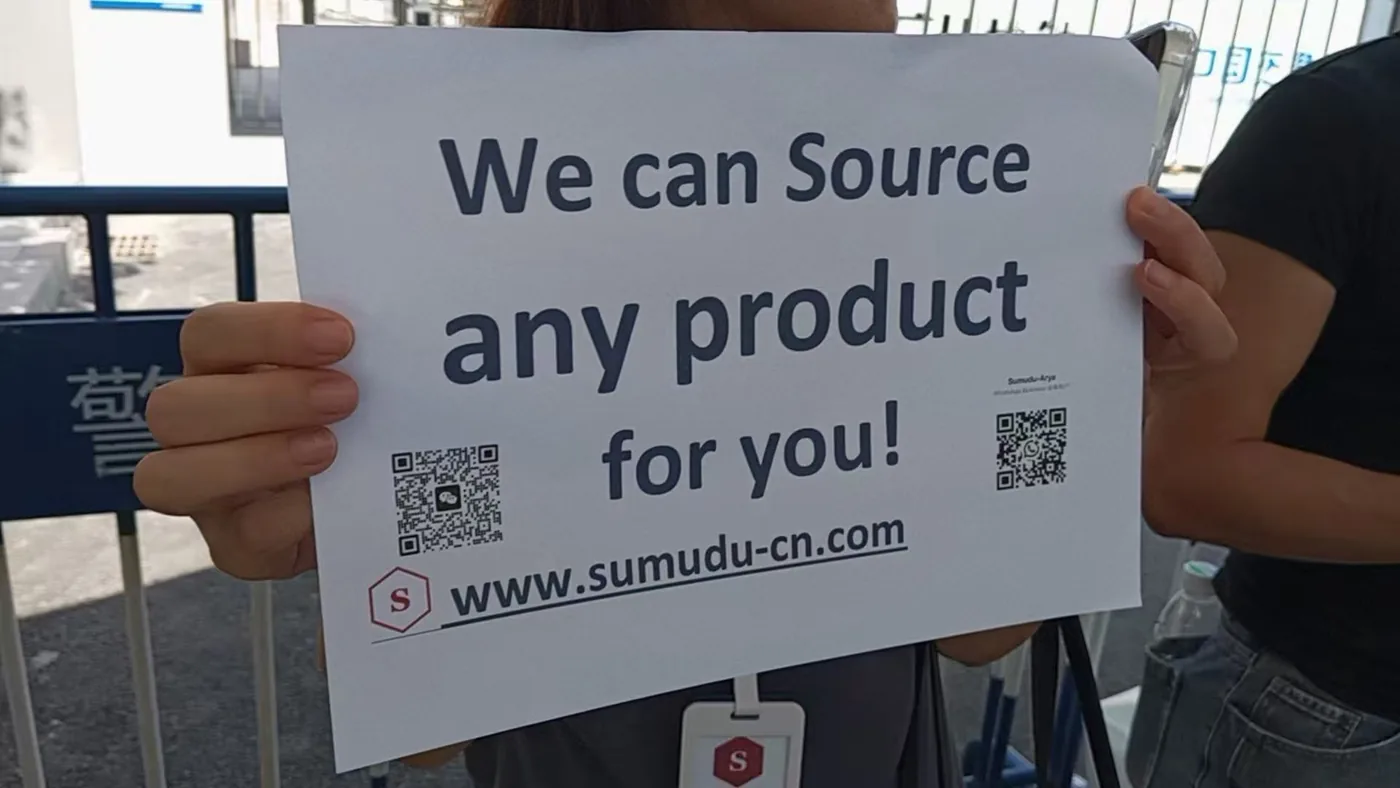
Let me be straight with you: we did not have a booth.
Not "we couldn't get one" — we didn't apply. We're a sourcing agent, not a factory and not a trader selling goods. Booths are for people selling things. What we do is find things for buyers, and that is oddly hard to do inside a hall where sixty thousand people are walking and there is nowhere to sit down and finish three sentences.
So we stood on the road outside Gate 1 for two days, with one A1 sign, three lanyards, two thousand leaflets, and two students we hired for the week.
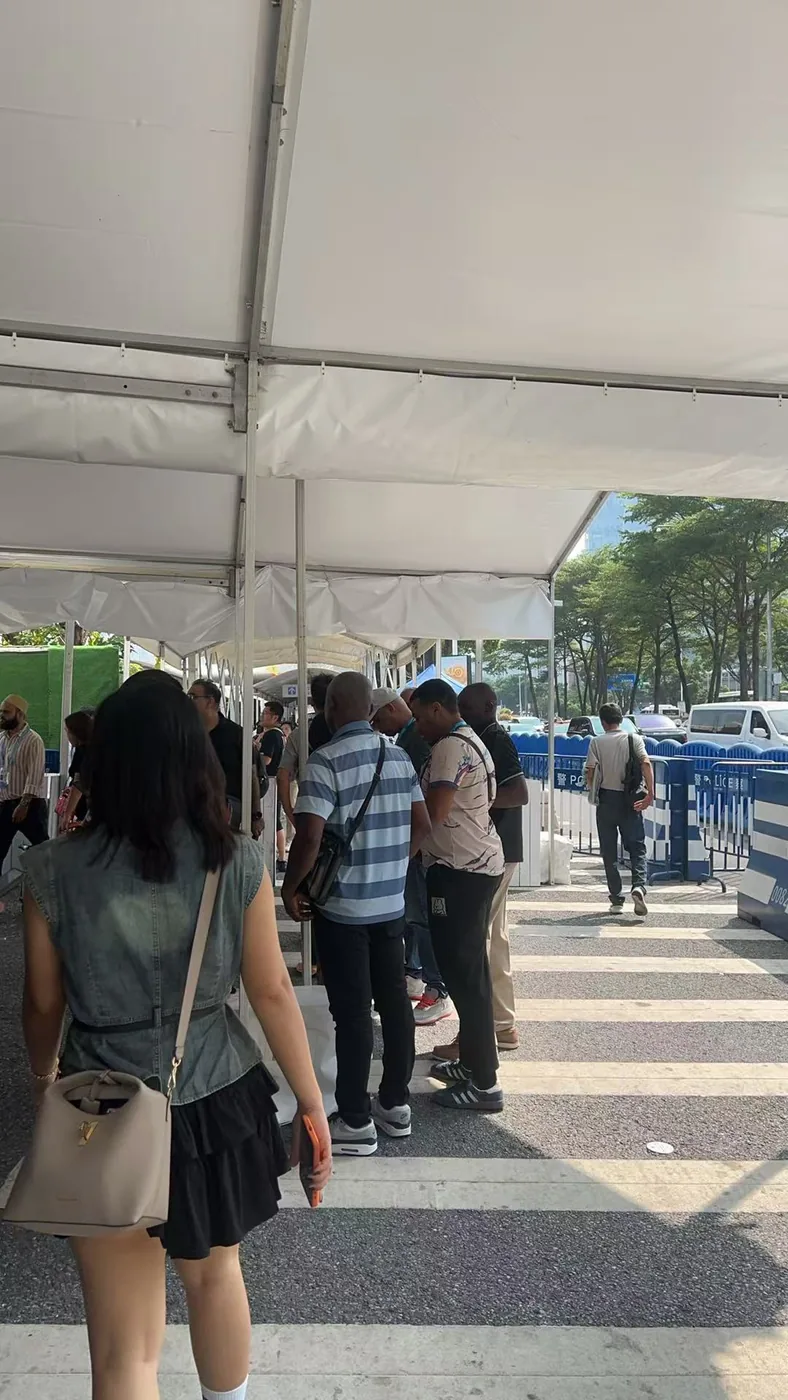
Day two, 08:20. The queue outside Gate 1 is already past the corner.
The sign
"We can Source any product for you!" — printed on two A1 boards, QR code and URL underneath.
Ten minutes in, the first person stopped and asked: "So what are you selling?"
"We don't sell anything. We find things."
"Oh." And off he went.
The third person asked whether we were scalpers. Fair question — there were plenty of actual scalpers twenty metres away, and their signs were better.
The fifth person was a buyer from Chile. He stood in front of the board for about eight seconds, took out his phone and scanned it. Eight seconds. That is the entire test of whether a sign was worth printing.
The lanyards
We had three made: one for each of us, one for each student. Red, with the S logo on the front and a QR code on the back — identical to ours.
Why bother? Because everyone who looks official at that gate is wearing one. With a lanyard you get three seconds of attention. Without one you are a person handing out flyers, and people's eyes slide right off you.
The three lanyards cost less than a hundred yuan. What they bought was this: two students who had never been to China's biggest trade fair could explain who they work for in about five seconds — without explaining anything. The badge did it.
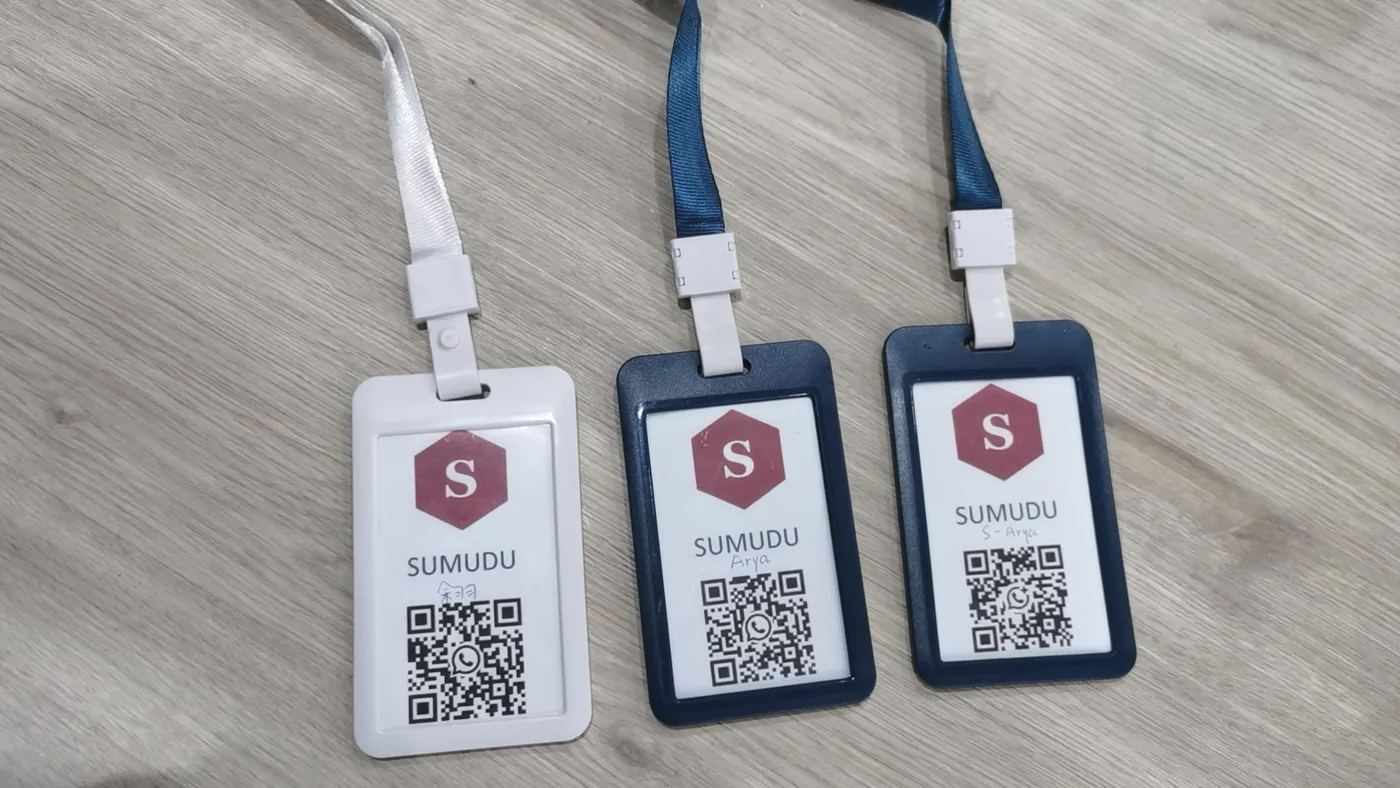
Three lanyards. The QR code on the back does the introductions.
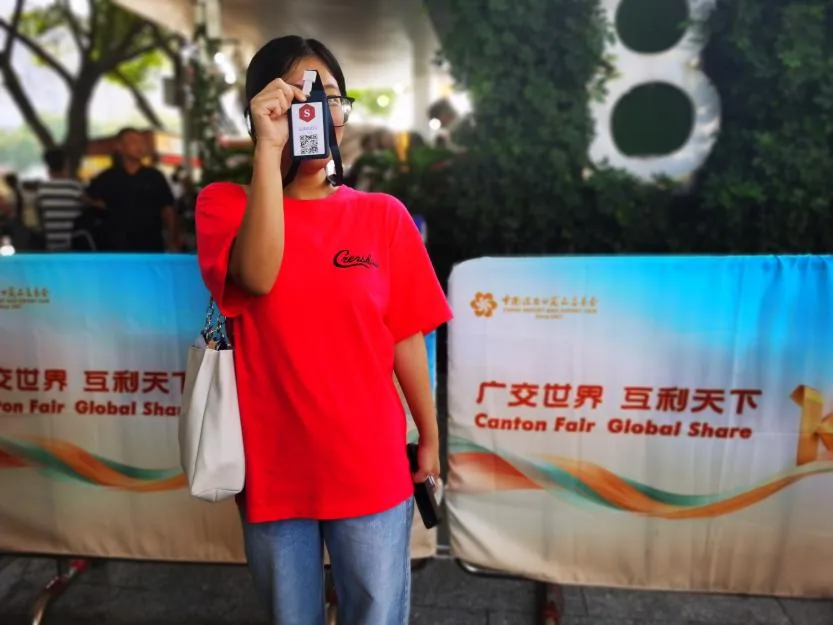
One of the two students we hired for the week. She had never worked a trade fair before; the badge meant she never had to open with "let me explain who we are".
The paper
Two thousand leaflets. Front: what we actually do. Back: QR code, phone, email, the Dongguan address.
We handed out maybe seven hundred. Some of the rest were confiscated — genuinely, security kept moving us along on the grounds that we were blocking the walkway. Some of the rest got rained on.
One German buyer slid our card into his badge holder, right next to his Canton Fair buyer pass. "This one is useful," he said. I did not have the nerve to photograph his chest.
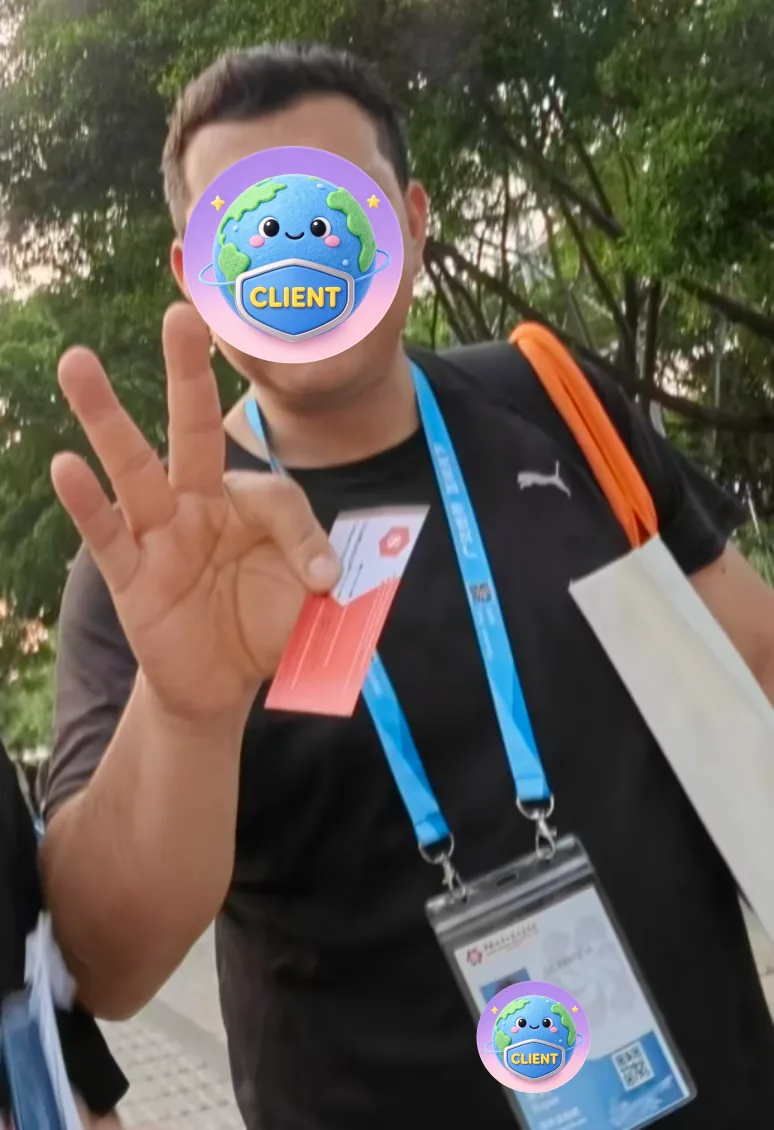
He kept the red card in his hand for the rest of the conversation. We blurred his face before publishing; we did not have to ask him to hold it up.
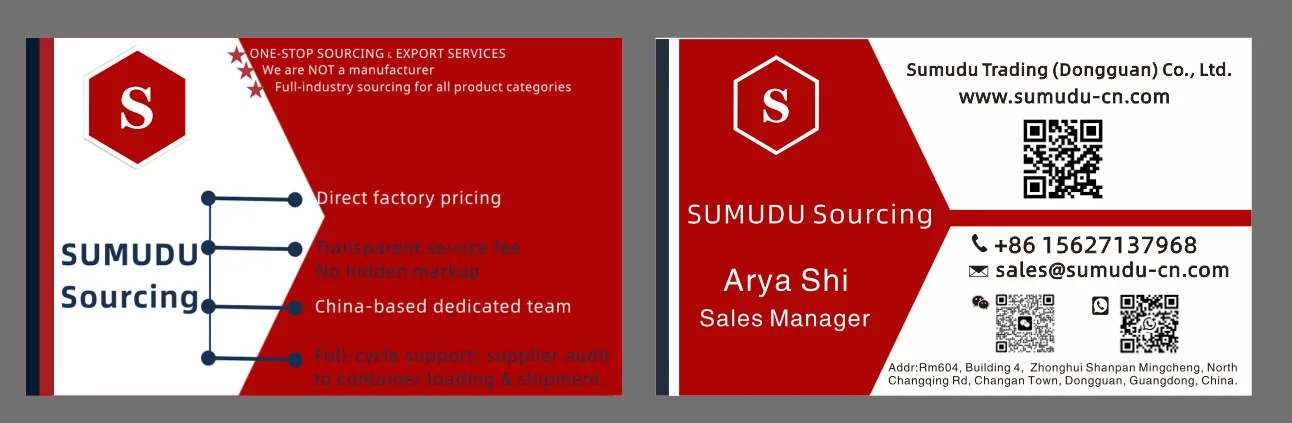
The leaflet, front and back. Everything a buyer needs to check us out before he trusts us with a quote.
The numbers, unvarnished
Two days. Forty cards with actual names on them. Twenty people added us on WhatsApp.
At 12:02 on the 17th, the first one came through. His opening message was "I'm ____ PD" — product development — followed by a photo of the two of us that he had taken himself.
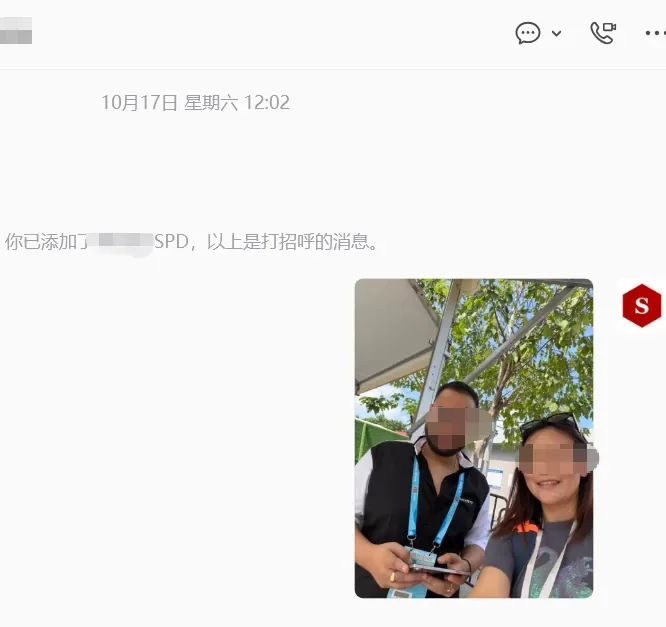
The first WhatsApp add of the fair. He sent his own photo before we asked for anything.
Of the forty cards: about half said "I'll email you", which in practice means nothing. Nine led to an actual enquiry. Three got a quote. One placed a trial order.
Is that a good conversion rate? Honestly? It's average. But compare it to the alternative — paying for a booth and coming home with a hundred scanned contact cards that nobody ever opens — and we'll take it.
Three things we said no to
- Carry your samples home for you. A buyer asked us to put two boxes in our luggage and bring them to Europe. No. Not because we're unhelpful, but because once that leaves customs in our name, it becomes our problem in a way we cannot control.
- Be your interpreter, by the hour. We're bad at it, and a professional interpreter is cheaper. Hiring us for that would be a waste of your money.
- "Just make a sample and see." No drawing, no BOM, no target price — we don't even have the standing to ask a factory.
If you're going next year
Three things we got wrong, so you don't have to:
- Don't hand out leaflets opposite Gate 8. Security comes by every ten minutes. Walk two hundred metres toward Pazhou station — same crowd, nobody bothers you.
- After 3pm the footfall falls off a cliff. Nine to noon is the whole day.
- Bring an umbrella. It rained, and a third of our leaflets turned to pulp.
Who we actually are
If you want to check that we're a real company: our business license is on the About page, and the registration number 91441900MAKBTADYX3 is searchable in any Chinese company registry. Our registered address, phone and legal name are all on that same page — no PO box, no virtual office.
If you want the awkward questions answered — are you really the cheapest, what happens if it goes wrong, who pays for rework — there are eighteen of them on our FAQ & Customer Q&A page.
We didn't write this to look clever. Standing outside a trade fair for two days is a fairly dumb thing to do.
But it is dumb in an honest way: we weren't inside, so we stood outside. We had no booth, so we made a sign. You weren't going to walk over to us, so we spoke first.
We'll be there next year. Look for the board that says "We can Source any product for you!" You'll get a card, and a WhatsApp number that actually answers.